
How Does Solar Power Work?
A clear, step-by-step explanation of how sunlight becomes electricity in your home — from the photovoltaic effect inside a panel to the power point on your wall.
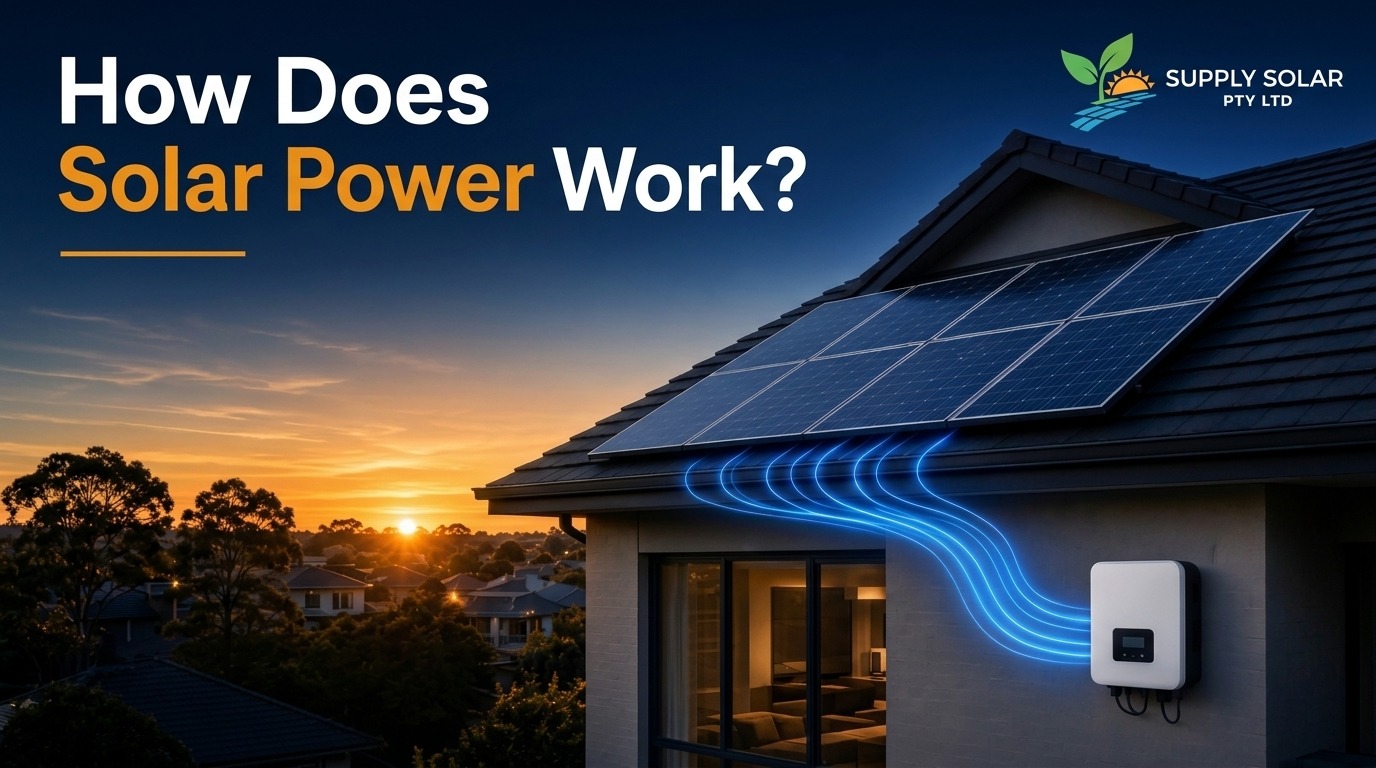
Most Melbourne homes need 16 to 24 solar panels. As a simple rule of thumb: divide your average daily electricity usage (kWh) by 1.6 — the typical daily output of a modern 430-440W panel in Melbourne after system losses. For example, a home using 26 kWh a day needs roughly 16 panels (a 6.6kW system), while a home using 40 kWh a day needs roughly 24 panels (a 10kW system).
What Is Solar Power?
Solar power is electricity generated from sunlight. It relies on a physical process called the photovoltaic effect — first observed in 1839 and now refined into the rooftop solar panels installed on more than four million Australian homes. No moving parts, no combustion, no emissions on-site: a solar panel simply sits in the sun and produces electricity for as long as light hits it.
For a Melbourne homeowner, understanding this process matters for one practical reason: it explains why system size, panel orientation, inverter choice and battery storage all affect how much of your own electricity you actually end up using — which is the whole point of going solar.
The Photovoltaic Effect Explained
Every solar panel is built from dozens of individual solar cells, most commonly made from crystalline silicon — the same semiconductor material used in computer chips. Each cell is treated with trace elements to create two layers with different electrical properties: a phosphorus-treated top layer with spare electrons, and a boron-treated bottom layer with “holes” wanting electrons.
When sunlight (specifically, photons) hits the cell, it transfers energy to electrons in the silicon, knocking them loose from their atoms. The built-in electric field between the two layers pushes these freed electrons to flow in one direction. That directional flow of electrons is electric current — specifically, DC electricity.
In plain terms
A solar cell doesn’t “store” sunlight — it converts light energy into electrical energy in real time. The moment the sun goes behind a cloud or sets, generation drops or stops immediately.
What’s Inside a Solar Panel?
A standard residential panel — what installers call a “module” — is more than just cells. It’s a layered sandwich engineered to survive 25+ years on a Melbourne roof:
- Tempered glass on top — lets light through while resisting hail, UV and impact
- Encapsulant (EVA film) — bonds and protects the cells from moisture
- Solar cells — typically 108-144 cells wired in series, monocrystalline for most modern residential panels
- Backsheet — a weatherproof layer that seals the rear of the panel
- Aluminium frame — structural support for roof mounting
- Junction box & cabling — carries the DC electricity out to the rest of the system
A typical Tier 1 residential panel installed in 2026 produces around 430-440 watts under standard test conditions, at roughly 21-22% efficiency — meaning it converts about a fifth of the sunlight energy hitting it into usable electricity. This is why our residential solar systems are sized in kilowatts (kW): a 6.6kW system uses around 15-16 of these panels.
From Sunlight to Switch: The 5-Step Journey
Here’s exactly what happens between a sunny Melbourne morning and your kettle switching on:
1
Sunlight hits the panels
Photons strike the silicon cells on your roof, triggering the photovoltaic effect and generating DC electricity.
2
DC electricity travels to the inverter
Cabling carries the direct current from every panel (or string of panels) down to an inverter, usually mounted in a garage or on an external wall.
3
The inverter converts DC to AC
The inverter rapidly switches the current’s direction back and forth, producing 230V AC electricity that matches the Australian grid standard.
4
AC power reaches your switchboard
From the inverter, AC electricity feeds into your home’s switchboard and is used first by whatever is running — your fridge, lights, air conditioning.
5
Excess power is stored or exported
Anything you don’t use is sent to a home battery if installed, or exported to the grid for a feed-in tariff credit on your electricity bill.
DC vs AC: Why Every System Needs an Inverter
This is the single most misunderstood part of how solar works, so it’s worth spelling out clearly.
| Direct Current (DC) | Alternating Current (AC) |
|---|---|
| Electricity flows in one direction only | Electricity reverses direction 50 times per second in Australia |
| Produced by solar panels and stored in batteries | Used by the electricity grid and almost all household appliances |
| Cannot run standard appliances or feed into the grid directly | Required to run lights, appliances, and to legally export to the grid |
Without an inverter, the electricity your panels generate would be unusable in a standard Australian home. Two main inverter types are used on Melbourne homes: string inverters, a single central unit for the whole system, and microinverters or power optimisers, which sit under each panel and manage output individually — useful on roofs with shading or multiple angles.
What Happens on Cloudy Days or at Night?
Solar panels respond to daylight, not direct sunshine specifically, so they continue generating on overcast Melbourne days — just at a reduced rate, typically 10-25% of clear-sky output depending on cloud density. This is why system sizing is based on your average annual usage and Melbourne’s real-world sun-hours data, not a single sunny day.
At night, panels generate nothing — there’s no light to trigger the photovoltaic effect. Two things determine what happens next:
- No battery: your home automatically draws electricity from the grid, exactly as it did before you had solar.
- With a battery: stored daytime solar powers your home instead, often eliminating or sharply reducing your overnight grid draw.
Solar + Battery Storage: How It Changes the Equation
A solar-only system is most efficient when you use electricity while the sun is up — which doesn’t suit every household’s schedule. Adding a home battery like a Tesla Powerwall, Sungrow SBR/SBH, GoodWe ESA or Sigenergy SigenStor inserts one extra step into the journey: instead of sending all your excess DC-turned-AC power straight to the grid, the system routes it into the battery first, ready to run your home in the evening, overnight, or during a blackout (with the right backup-capable setup).
Why this matters financially
Electricity exported to the grid earns a small feed-in tariff (often just a few cents per kWh), while electricity you use yourself offsets a much higher retail rate. A battery lets you “use” more of your own solar instead of selling it cheap and buying it back expensive.
Grid-Connected vs Off-Grid Systems
Almost every residential solar system in Melbourne is grid-connected: the grid acts as a backup and an export market rather than something you’re trying to avoid entirely. An off-grid system disconnects from the network completely, which sounds appealing but requires a battery bank large enough to cover the worst week of winter cloud cover — usually far more expensive than the savings justify for a typical home. Grid-connected solar with or without a battery remains the standard, cost-effective approach for the vast majority of Victorian households.
How Much Electricity Does a Solar System Actually Produce?
Output depends on system size, panel orientation, shading and Melbourne’s seasonal sun hours. As a rough guide for a well-oriented, unshaded system in Melbourne:
| System Size | Approx. Daily Output | Best Suited For |
|---|---|---|
| 6.6kW | ~24-27 kWh/day | Smaller homes, 2-3 person households |
| 10kW | ~36-40 kWh/day | Family homes, daytime usage, pools |
| 13kW | ~47-52 kWh/day | Larger homes, ducted heating/cooling |
| 20kW | ~72-80 kWh/day | Big households, EVs, all-electric homes |
These figures assume typical Melbourne conditions across the year and a north-facing, unshaded roof. Your actual output depends on your specific roof — which is exactly what a free site assessment is for.
Curious how much solar your roof could produce?
Get a free, no-obligation quote with your exact system size, output estimate and rebates applied.
Frequently Asked Questions
How does solar power work in simple terms?
Solar panels contain photovoltaic cells that convert sunlight directly into DC electricity. An inverter then converts that DC electricity into the AC electricity your home uses. Power flows to your appliances first, with any excess sent to the grid or stored in a battery.
Do solar panels work on cloudy days?
Yes. Solar panels still generate electricity in cloudy or overcast conditions because they respond to daylight, not direct sunlight alone. Output typically drops to around 10-25% of a clear-sky day, which is why systems are sized around average annual conditions rather than peak sun.
Do solar panels work at night?
No, solar panels need daylight to generate electricity and produce nothing after dark. Homes without a battery draw from the grid overnight. A battery stores excess daytime solar so it can power the home after sunset instead.
What is the difference between DC and AC electricity in a solar system?
Solar panels generate direct current (DC) electricity, where power flows in one direction. Australian homes and the grid run on alternating current (AC), where the flow reverses direction repeatedly. An inverter is required to convert the panels’ DC output into usable AC power.
What happens to unused solar electricity?
Any solar electricity your home doesn’t use immediately either charges a home battery, if installed, or is exported to the electricity grid. Exported power earns a feed-in tariff credit from your electricity retailer, which appears as a discount on your power bill.
How long do solar panels take to generate electricity once installed?
Solar panels start generating electricity the moment they’re connected and exposed to daylight — there’s no warm-up period. Once your installer completes grid connection approval, the system switches on and begins offsetting your electricity use immediately.
Can a solar system work without being connected to the grid?
Yes, this is called an off-grid system, but it requires a much larger battery to cover every night and every low-sun period year-round. The vast majority of Melbourne homes use grid-connected systems, which are simpler, cheaper, and use the grid as backup instead of a large battery bank.